

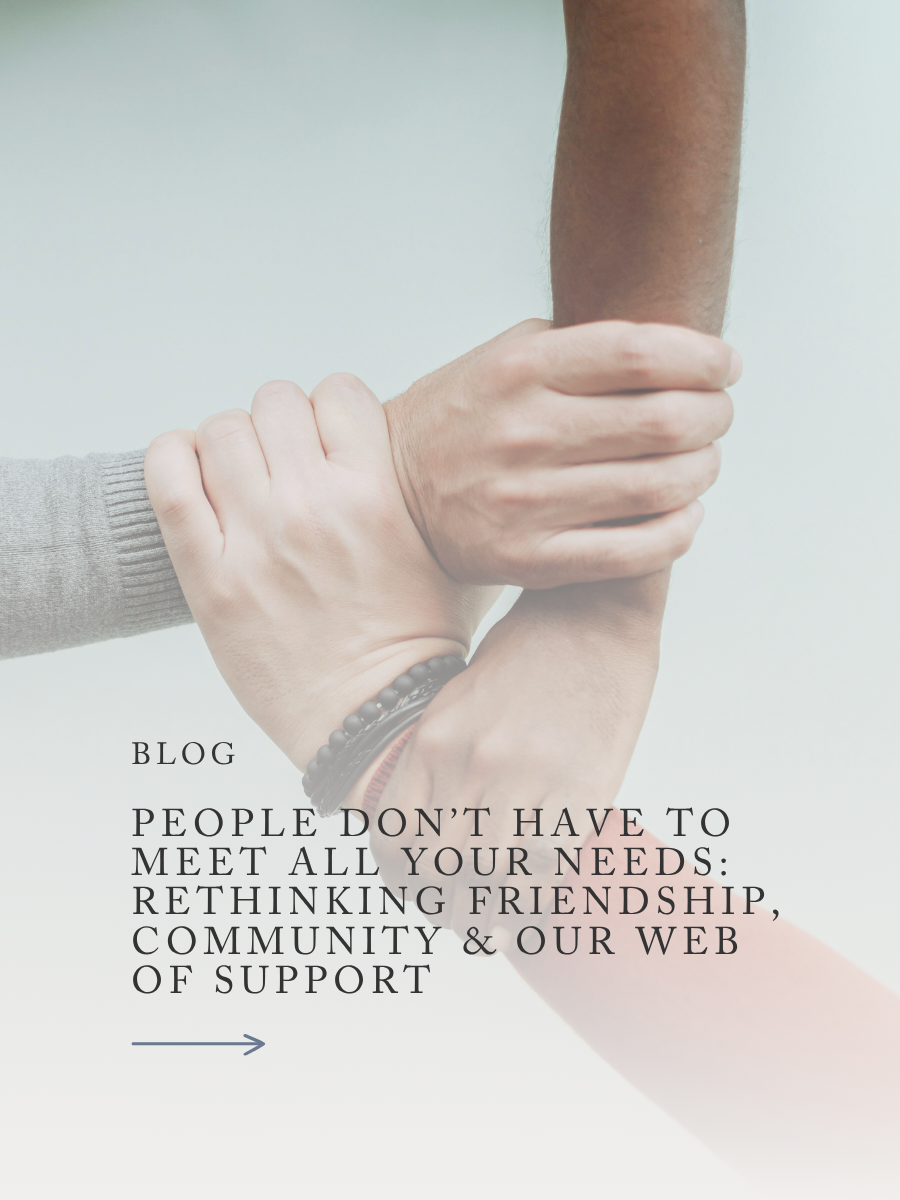
The Importance of Having More Than One Kind of Connection
Recently, I was having a conversation with someone about the importance of having different types of connections within our web of support.
It got me thinking about something I come back to again and again, both personally and professionally:
What if we stopped expecting one relationship to meet every relational need we have?
I want to be careful here, because I am not suggesting that building and maintaining meaningful relationships is easy.
It isn't always.
Close relationships require ongoing effort, reflection, accountability, responsibility, vulnerability, time, emotional energy and, quite frankly, capacity.
And most of us are already stretched.
After paying the bills, caring for children, preparing meals, cleaning, working, keeping up with appointments, walking the dog, taking care of aging parents, going to the dentist, managing school, volunteering, dating, studying, building a career, or simply trying to keep ourselves reasonably functional...
The bandwidth left over can feel pretty thin.
And we are not alone in this.
Most of the people I interact with, personally and professionally, are not walking around with a surplus of time and emotional resources.
Which can make building and maintaining friendships and community feel like just another item on the never-ending to-do list.
“I invited them last time. They obviously don't care.”
Maybe.
Or maybe they have too much on their plate.
Maybe you would have had a beautiful friendship if you had met during a different season of life, but right now they are at capacity with the relationships and responsibilities they already have.
That doesn't necessarily mean rejection.
Sometimes it simply means this is what this person has capacity for right now.
And there are multiple truths that can exist at the same time.
You can feel disappointed and understand.
You can wish for more and appreciate what is there.
You can recognize that a relationship isn't meeting all of your needs without deciding that the relationship has no value.
Different People Can Meet Different Needs
One question I have been sitting with is:
Do I need this particular person to meet this particular need, or do I need to expand my web of support?
Maybe there is a friend you can't talk to about certain things.
But do you enjoy what the relationship does bring?
Maybe another person is wonderful for deep conversations but isn't the person you call when you want to go for a spontaneous walk.
Maybe someone else is fantastic for laughter, shared interests or adventure but isn't equipped for the kind of emotional processing you might want from a different relationship.
That doesn't necessarily make any of these relationships less meaningful.
It may simply mean they serve different purposes.
We can sometimes throw away good relationships because they aren't giving us everything we need, when what might actually be needed is a wider network of connection.
When we have more than one source of support, we place less pressure on any single relationship to carry everything.
And that can actually create more freedom and ease within our closest relationships.
The Friendship I Have to Schedule
I have a few long-term friendships that I deeply love and value.
Ones where we don't live in the same city. I hardly travel. If we relied on accidentally bumping into one another or finding a magical free afternoon, our friendship probably wouldn't survive.
So we schedule it.
I literally started booking time with one friend through their online scheduling system. With others, it is common for us to be texting back and forth to schedule something weeks or even months in advance.
With young children, many of these plans are rescheduled when someone is sick.
I won’t lie, it takes emotional labour to keep going.
Is that my ideal version of friendship?
Honestly, no.
Would I rather be able to see them face-to-face, sit across from them and give them a hug?
Absolutely.
But that isn't the reality of our lives right now.
And I would rather adapt the form of the relationship than lose the relationship itself.
Technology has given us a beautiful gift here.
Some of my closest and longest-standing friendships exist across different cities and provinces. They aren't part of my day-to-day physical world, but that doesn't make them insignificant.
We both make an effort.
And effort matters.
At the same time, I have also met people who have allowed long-distance friendships to fade because not having someone physically present in their day-to-day life simply didn't work for them.
And there is truth in that too.
There is no single right way to do friendship.
We need face-to-face connection. We need local community. We also need the people who know us across time and distance.
The goal isn't to find one perfect structure.
It is to become more honest about what we need, what we have, and what we are willing and able to invest.
When Everyone Is Busy, What's the Point?
This is another question I understand.
Sometimes it really does feel like a lot of work.
Emotional labour is a form of labour. Something that has traditionally disproportionately fallen on women. I am not suggesting that women should take on responsibility for all relationships in their family and circle. This is a separate discussion.
But the fact that something requires effort doesn't mean it isn't worth doing.
Relationships require investment.
Sometimes that investment looks like initiating.
Sometimes it looks like following up.
Sometimes it means putting something in the calendar three months in advance.
Sometimes it means being willing to be the person who reaches out again.
And sometimes it means recognizing that you have reached out enough and leaving the ball in the other person's court.
The important part is knowing what the difference feels like for you.
A Bigger Web
Perhaps the bigger invitation is to stop asking one relationship to be our entire world.
A romantic partner cannot be our entire support system.
A best friend cannot be our therapist, social life, emotional processing partner, adventure companion and emergency contact all at once.
And no single person should have to carry the entirety of our belonging.
We are relational beings.
We need different kinds of connection.
Some relationships are intimate.
Some are playful.
Some are intellectual.
Some are spiritual.
Some are built around shared interests.
Some are rooted in history.
Some are new.
Some are local.
Some exist across distance.
Some may only belong to one particular season of our lives.
And some will become lifelong.
There is something freeing about allowing our relationships to be what they actually are, rather than constantly measuring them against what we think they should be.
Reflection
As you think about your own web of support, consider:
What different kinds of connection do I currently have in my life?
Am I expecting one person or one relationship to meet too many of my needs?
Where might I benefit from expanding my network rather than asking an existing relationship to become something it isn't?
Are there relationships I have dismissed because they don't look the way I expected friendship or connection to look?
Where could I be more intentional about making time for the people I value?
Is there somewhere I am over-functioning relationally, doing all the initiating or investing without enough reciprocity?
What kind of connection am I craving right now?
Where might I be willing to make the first move?
Building Community as an Adult Can Be Messy
It can be disappointing.
It can bring up old stories about rejection, worthiness and belonging.
And it can also be deeply nourishing.
The goal isn't to find only one or two people who can meet every need.
We are wired to be in community, and community requires a web of support and connection.
One that has enough diversity, flexibility and reciprocity that no single relationship has to hold everything.
A web allows for movement within it. People come and go. We get closer and grow more distant at different times in our lives.
And perhaps that is a more sustainable kind of belonging.
We also need systemic changes on a collective level. This is another topic/discussion, but I didn’t want to leave it out.
We are all stretched thin as part of the culture and systems we live within.
If This Is Something You're Exploring...
This is part of the deeper work I explore through Divine Feminine Rising: moving beyond autopilot and into a more embodied relationship with ourselves, our intuition, our relationships and our lives.
It is a space for women who have already done meaningful personal growth work and are ready to explore what comes next: deeper self-trust, embodiment, healthy relational patterns, boundaries, community, healing and leadership.
I am currently still enrolling for the upcoming Divine Feminine Rising circle. It is intentionally small and intimate, with space for meaningful conversation, reflection, embodiment and connection with other women who are also committed to doing their own work.
If you have been feeling called toward deeper community and a more embodied way of relating, you can learn more about the upcoming circle here.