

Why Some People Are More Vulnerable to Burnout Than Others
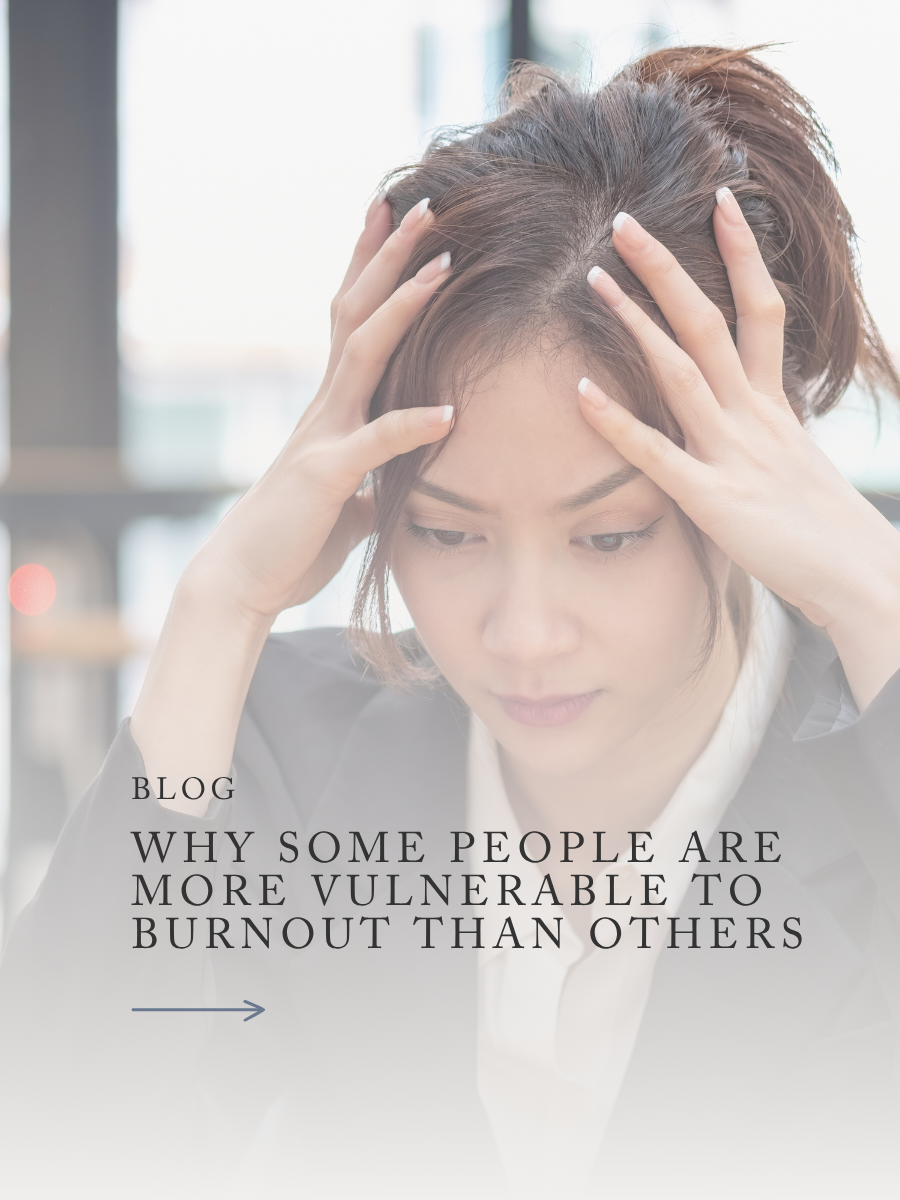
Many people experiencing burnout are highly responsible, caring, hardworking individuals. In fact, those who are exceptionally good at pushing through challenges may be particularly vulnerable because they can continue functioning long after their reserves have been depleted.
The goal is not to avoid all stress. Stress is a normal part of life. The goal is to create enough balance, support, and recovery that periods of high demand do not become chronic states of exhaustion.
While workload certainly matters, burnout is usually more complex than that.
I've worked with many clients who are carrying similar responsibilities as the people around them, yet they find themselves exhausted, overwhelmed, and approaching burnout while others appear to be coping reasonably well. This doesn't mean they're weaker, less resilient, or doing something wrong.
Burnout is rarely caused by a single factor. Instead, it tends to develop when multiple risk factors stack on top of one another over time.
3 Factors that Contribute to Burnout Risk
Personal factors
Situational or role-related factors
Social and systemic factors
The more challenges we face across these layers, the more vulnerable we may become to burnout.
The encouraging news is that understanding these factors can help us identify areas where change is possible.
Personal Factors: The Strengths That Can Sometimes Work Against Us
When people hear about personal contributors to burnout, they sometimes assume this means burnout is their fault.
That isn't what I mean at all.
Many of the personal characteristics associated with burnout are actually qualities that help people succeed in life. The challenge is that these same strengths can become liabilities when they are not balanced with self-awareness and healthy boundaries.
Some common personal contributors include:
Perfectionism
High self-expectations
People-pleasing tendencies
Difficulty asking for help
Indirect communication styles
A tendency to overfunction
Strong responsibility toward others
A pattern of overfuncintioning in times of stress.
One pattern I frequently see is overfunctioning.
Overfunctioners tend to respond to stress by working harder.
When life becomes overwhelming, they put their heads down and focus on getting through the next task. They become highly efficient problem-solvers. If something needs to be done, they figure out a way to do it.
This approach can be incredibly effective in the short term.
The problem is that overfunctioning rarely includes stepping back and asking important questions such as:
Is this workload realistic?
Would this be sustainable for anyone?
What needs to change?
What can I let go of?
Where do I need support?
What conversations am I avoiding?
Is there anything I am avoiding feeling by keeping busy?
Instead of evaluating the situation, many overfunctioners simply increase their effort.
For a while, that strategy may work. Eventually, however, there comes a point where no amount of effort can compensate for an unsustainable load.
Learning to Recognize Your Capacity
One of the most important burnout prevention skills is learning to accurately assess your own capacity.
Many people spend years responding to stress by pushing through discomfort. They become so accustomed to overriding their needs that they lose touch with their limits.
The challenge is that nobody else can determine or be responsible for your capacity for you.
Only you can recognize when your plate is full.
Only you can identify when something needs to shift.
Only you can communicate when expectations have become unrealistic.
This often requires difficult conversations, stronger boundaries, and a willingness to tolerate the discomfort that comes with disappointing others.
These skills don't come naturally to everyone. In fact, many of us were never taught them.
But they can be learned. And comfort can, (and does), increase over time and with practice.
Workplace and Role-Related Contributors
While personal factors matter, burnout is never solely an individual problem.
Sometimes people blame themselves for burning out when the reality is that they are functioning within circumstances that would overwhelm almost anyone.
Workplace and role-related contributors can include:
Excessive workloads
Chronic understaffing
Lack of support
Unclear expectations
Limited control over responsibilities
Constant interruptions and competing demands
Insufficient time to complete tasks
Poor work-life balance
Unhealthy and toxic workplace dynamics
These same principles apply outside of paid employment.
Parents, caregivers, students, and volunteers can all experience burnout when the demands placed upon them consistently exceed the resources available to meet those demands.
One of the strongest predictors of burnout is feeling as though there is never enough time to complete what needs to be done.
When the to-do list grows faster than our ability to address it, we begin operating in a state of chronic catch-up. Eventually, this creates ongoing stress, exhaustion, and a sense that we're constantly falling behind.
Many of the clients who I work with in life stages with completing demands describe exactly this experience.
It's not necessarily one responsibility that is causing burnout. It's the cumulative weight of parenting, household responsibilities, employment, caregiving, emotional labour, and the countless invisible tasks that add up to an unsuitable load.
Burnout Is Often a Recovery Problem
When discussing burnout, we tend to focus on workload.
However, burnout is not just about how much we're doing.
It's also about whether we have enough opportunities to recover.
Human beings can tolerate significant periods of stress. In fact, we're designed to respond to challenges and adapt.
The problem occurs when stress becomes chronic and recovery becomes scarce.
Many people spend years operating in a cycle of constant output.
They're caring for others.
Meeting deadlines.
Managing responsibilities.
Solving problems.
But they're rarely engaging in activities that genuinely restore their physical, emotional, and mental energy.
Eventually, the body (or mental health) will start to say “enough.
For some people, this shows up as anxiety. For others, depression. For others, physical symptoms, chronic fatigue, sleep difficulties, or ongoing health concerns or a mix of all of the above.
While every person's experience is unique, our minds and bodies generally have limits to how long they can function in survival mode.
The Bigger Picture: Social and Systemic Factors
There is another layer of burnout that often receives less attention.
The reality is that people do not experience stress equally.
Our experiences are shaped not only by our personal choices and circumstances but also by broader social, cultural, and systemic factors.
These can include:
Gender expectations
Racism and discrimination
Disability-related barriers
Neurodiversity
Financial inequality
Weight stigma
Heterosexism and homophobia
Cultural expectations around caregiving and productivity
These factors can create additional stress, additional barriers, and additional emotional labour that may not be visible to others.
Acknowledging these realities is not about assigning blame or suggesting that if you hold more privilege in society that you haven’t worked hard for what you have and that you don’t have your own struggles.
Rather, it is about recognizing that some individuals face challenges that require significantly more energy to navigate on a daily basis, and that membership in certain groups face additional barriers based on group membership alone.
When we ignore these factors, we risk overlooking important pieces of the burnout puzzle. And we can help to be more compassionate towards ourselves when we are facing additional barriers and use the privileges we do hold to help advocate for more inclusivity and equality.
Awareness Creates Choice
The good news is that understanding burnout risk factors gives us more opportunities to intervene.
We may not be able to change every aspect of our workplace, family responsibilities, or broader social systems.
However, we can begin to notice the patterns that keep us stuck.
We can challenge unrealistic expectations.
We can develop healthier boundaries.
We can communicate our needs more directly.
We can learn to recognize when we're operating beyond our capacity.
Most importantly, we can stop viewing burnout as a personal failure and start understanding it as a signal.
A signal that something in our current way of living is no longer sustainable.
And once we recognize that signal, we can begin making the changes necessary to protect our well-being for the long term.