

Understanding the spiral path of healing and growth, and why recurring patterns don't necessarily mean you're going backwards.
Have you ever found yourself in a situation and thought, Seriously? Haven't I already worked through this?
Maybe it's a familiar feeling in a relationship. That old fear of not being chosen, the urge to overthink, the discomfort with vulnerability, or the tendency to take responsibility for everyone else's feelings.
Perhaps you've spent years doing the inner work. You've been to therapy, read the books, explored your childhood, learned about your nervous system, recognized your patterns and made some significant changes.
And then something happens.
A familiar feeling shows up. You find yourself reacting in a way you thought you'd moved beyond. Or you notice yourself navigating a situation that feels remarkably similar to one you've encountered before.
It's easy to feel discouraged. To wonder whether all that work really made a difference.
But what if you're not actually back at square one?
What if you're meeting something familiar from an entirely different place?
Healing Isn't a Straight Line
I sometimes think about walking a mountain trail. You climb higher and higher, following what appears to be a path towards the summit. But the trail doesn't take you in a straight line. It winds around the mountain, sometimes taking you in a direction that makes it feel as though you're going backwards.
If you only look at the direction you're facing, you might wonder whether you've lost your way.
But if you look at how far you've climbed, you realize something different.
You're not where you started.
Healing often works this way.
We tend to imagine personal growth as a linear process. We identify a pattern, understand where it came from, work through it, and eventually leave it behind.
And while there can certainly be moments of significant breakthrough, the deeper process of healing and growth is rarely so straightforward.
We revisit familiar themes, but we don't necessarily revisit them as the same person.
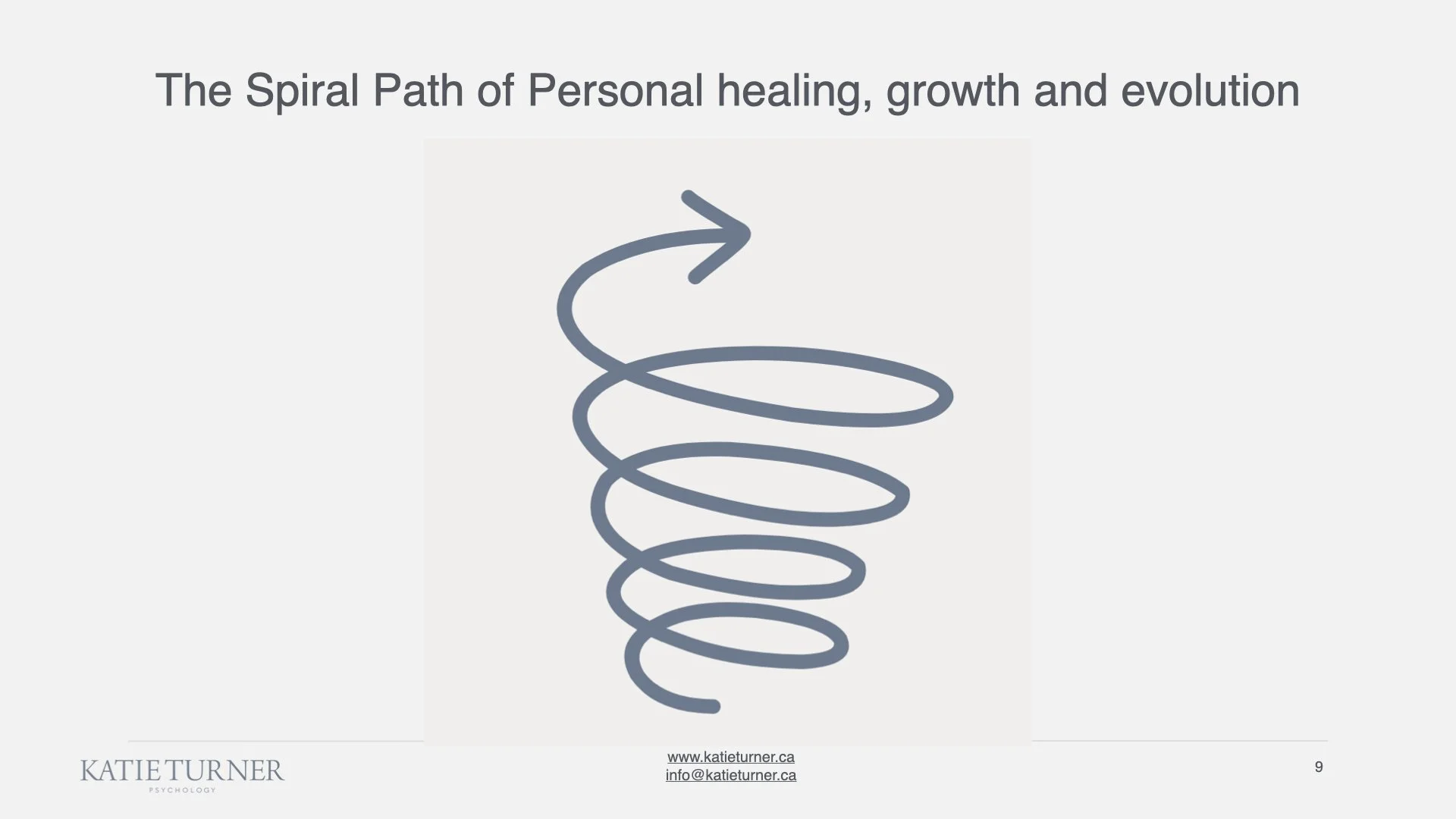
The spiral is a much more helpful metaphor. We may circle back to familiar experiences, emotions and challenges, but each time we have an opportunity to bring a different level of awareness, understanding and integration to what we're experiencing.
Recognizing an Old Pattern Doesn't Mean You're Back Where You Started
Think about a relationship pattern you've worked hard to change.
Perhaps in the past, you would abandon your own needs to maintain connection. You might have struggled to speak up, set boundaries or tolerate the discomfort of disappointing someone.
Maybe you learned early in life that keeping the peace, anticipating other people's needs or being easy to love was important for maintaining connection.
Over time, you've worked to understand these patterns. You've developed greater awareness of your needs, learned to recognize your emotional responses and begun making different choices.
Today, you might recognize that same discomfort arising in a relationship.
But perhaps you notice it sooner. Perhaps you can pause rather than automatically accommodate. Perhaps you can express what you need, even when it feels uncomfortable.
The feeling might be familiar, but your relationship with it has changed.
That's growth.
Sometimes the progress isn't that we no longer experience an old fear. It's that the fear no longer gets to make all our decisions.
Sometimes it's that we recover more quickly, recognize what's happening sooner, or offer ourselves compassion instead of criticism.
And sometimes the growth is much quieter. We simply make a different choice.
Why Do We Keep Revisiting the Same Patterns?
There are a few reasons we might find ourselves revisiting familiar experiences as we move through the healing process.
1. Our awareness continues to expand.
As we grow, we begin to recognize patterns that we couldn't see before. We become more conscious of the ways our past experiences, protective strategies and unconscious beliefs influence how we navigate the present.
Something that once felt like simply being anxious, for example, might eventually be understood as a protective response connected to earlier experiences of unpredictability or disconnection.
The more awareness we develop, the more opportunities we have to recognize what is happening beneath the surface.
2. We develop the capacity to explore deeper layers.
Sometimes we can understand something intellectually long before we're able to work with it emotionally or integrate that understanding into our everyday lives.
For example, someone might initially recognize that they struggle with boundaries. As they begin to change this pattern, they might discover a deeper fear underneath it: the fear of rejection, abandonment or not being loved.
Working with that fear might then reveal something even deeper about their sense of worth and belonging.
The original pattern hasn't necessarily disappeared. We're understanding it in a new way.
This is one reason healing can feel like peeling back layers. As we develop greater emotional capacity, we may become ready to explore experiences and beliefs that weren't accessible to us before.
3. Life gives us new opportunities to practise.
We don't develop new ways of being in isolation. Our growth happens in relationship with ourselves, others and the world around us.
A boundary that was relatively easy to establish in one relationship might feel much more challenging in another.
Learning to trust ourselves when life is predictable is different from learning to trust ourselves when things feel uncertain.
And learning to remain open and vulnerable in a healthy relationship can bring up unexpected challenges for someone who has spent years protecting themselves from unhealthy relationships.
Sometimes we don't fully understand what we've learned until life gives us an opportunity to put it into practice.
When Personal Growth Becomes Another Way to Judge Ourselves
One of the traps of personal development is that we can unintentionally turn healing into another way of measuring our worth.
We start believing that if we've really done the work, we shouldn't get triggered. We shouldn't have difficult days. We shouldn't find ourselves repeating old behaviours or experiencing familiar insecurities.
We can become so focused on whether we're healed enough that we lose sight of the actual experience of living.
We might even begin judging ourselves for having human emotions.
But being human means continuing to encounter life, relationships, change, uncertainty and the full range of our emotional experiences.
The goal isn't to become someone who never struggles.
It's to develop a different relationship with ourselves through those experiences.
To recognize when an old protective strategy is taking over. To understand what might be happening beneath our reactions. To have the capacity to pause, reflect and choose a response that is more aligned with who we are becoming.
And sometimes, we will still get it wrong.
That's part of being human, too.
Revisiting an Old Pattern or Repeating an Unhealthy Dynamic?
There is an important distinction here.
Recognizing that healing is not linear doesn't mean we should simply accept recurring unhealthy experiences or assume that every repetition is evidence of growth.
Sometimes we are genuinely revisiting something with new awareness and a greater capacity to respond differently.
Other times, we may still be participating in a dynamic that isn't healthy for us.
The invitation is to become curious about the difference.
Are you noticing the pattern sooner? Are you making different choices? Are you becoming more aware of your needs and boundaries? Are you taking greater responsibility for your own responses without taking responsibility for everyone else's?
Or are you continuing to make the same choices, hoping someone else will eventually change, while abandoning parts of yourself in the process?
Growth isn't just about understanding our patterns. It's also about developing the capacity to do something different.
And sometimes that means recognizing when a situation, relationship or environment is not one we can heal our way through.
We can have compassion for ourselves while still taking responsibility for the choices available to us.
What If You're Further Along Than You Think?
So the next time you find yourself thinking, Here we go again, take a moment.
Perhaps you aren't back at square one.
Perhaps you're being given an opportunity to meet something familiar with a little more wisdom, a little more compassion and a little more freedom than you had before.
Rather than immediately asking, Why am I still dealing with this?, consider asking:
What am I noticing now that I couldn't see before?
What choices are available to me now that weren't available to me previously?
Where am I responding differently, even if the feelings themselves are familiar?
What might this experience be teaching me about myself?
Where might I be expecting myself to be further along than I need to be?
You might be surprised by how much has actually changed.
Remember, healing isn't about getting to a place where nothing ever comes up again. It's about becoming more conscious, more connected to yourself and more able to live from a place of choice rather than old conditioning.
We're all works in progress. And perhaps the journey isn't about finally being finished, but about learning to live more fully along the way.
Explore More: The Spiral Path of Healing and Growth
I explore this topic further in my video, When Your "Stuff" Keeps Repeating: More on the Spiral Path of Healing & Growth.
I also recently explored this topic in my free Psychology with Soul webinar and Q&A, looking more deeply at the spiral path of healing, personal growth and the integration of our experiences.
If you're navigating your own journey of healing and growth and looking for deeper connection, support and exploration, I invite you to explore my workshops and facilitated community spaces.
Because you don't have to have it all figured out to keep moving forward. And you don't have to do all of the inner work alone.
With love,
Katie